
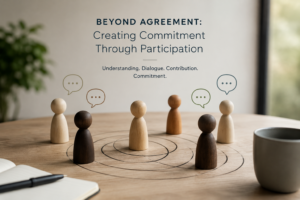
There is an assumption that often appears in professional and organisational life: if people agree with an idea, meaningful change will naturally follow.
In practice, I have found this relationship to be more complex. People may agree with a new strategy, policy, or direction while remaining uncertain about what it means for their everyday work. Others may express reservations, yet still contribute constructively because they understand the purpose behind the work and see how they can play a meaningful role within it. This makes me wonder whether agreement is always the most important place to focus our attention. Perhaps the more important question is how commitment develops.
Beyond Consensus
Many organisations place considerable effort into building consensus. Consultation, workshops, and engagement activities are often designed to bring people toward shared understanding.
These processes have value. They create opportunities to listen, explore different perspectives, and strengthen relationships. Yet agreement alone does not necessarily lead to action. People may leave a meeting broadly aligned with a decision, while still interpreting its implications in different ways. Others may support an initiative in principle but struggle to see how it connects with the realities of their own roles and responsibilities. The challenge, therefore, may not simply be reaching agreement. It may be creating the conditions in which people can genuinely engage with what happens next.
Participation as a Process
This is one reason I continue to be interested in participation. Participation is often described as involving people in decision-making. While this is important, I think it also involves something deeper. It creates opportunities for people to ask questions, test assumptions, contribute their own perspectives, and make sense of change within the context of their own experience.
In this way, participation becomes less about securing agreement and more about supporting understanding. When people have space to explore meaning together, commitment often develops more naturally.
The Role of Dialogue
Dialogue plays an important part in this process. Not because dialogue guarantees consensus, but because it allows different interpretations to surface before they become barriers to implementation.
In my own work, I have become increasingly interested in creating reflective spaces where people can explore ideas without feeling that every conversation must immediately produce a solution. Sometimes the most valuable outcome is not agreement itself, but a clearer understanding of why different perspectives exist and how they can contribute to a shared purpose.
A Reflection
Perhaps meaningful change depends less on persuading people to agree and more on creating environments where people can understand, participate, and commit. Agreement may be one step in the process, but it is rarely the destination. The question I continue to reflect on is not simply how organisations create agreement, but how they cultivate the conditions in which people choose to contribute meaningfully to what they are trying to achieve.